
Williamson Court Records After Arrest
A Williamson County jail arrest creates more than one public-record trail. The booking side starts with arrest, intake, identifying data, arresting-agency allegations, holds, and bond or magistration status. The court side starts when a complaint, information, indictment, or other charging instrument opens a criminal case in the proper court. The official Williamson County Court Case Lookup page separates those routes by linking to Criminal Case Records, Civil/Family/Probate Case Records, and Jail Lookup.
That split matters because a booking charge can change after prosecutor review. The District Attorney for the 26th Judicial District handles felony-level state criminal cases and related prosecutorial functions. After arrest, prosecutor review can leave a charge as filed, amend it, reduce it, add a new count, reject it, or move a felony toward grand jury indictment. For custody and booking details, use Williamson County jail inmate records. For booking photo questions, use Williamson County jail mugshots.
Search Williamson Criminal Case Records
The county links criminal court users to the Williamson County Criminal Case Records portal. Use that portal for charges filed after a jail arrest, case numbers, court settings, filings, charge status, and dispositions when those records are available online. Civil, family, and probate records use a separate link and should not be treated as the criminal case path for an arrest.
The criminal case portal was captured from the official county source set.
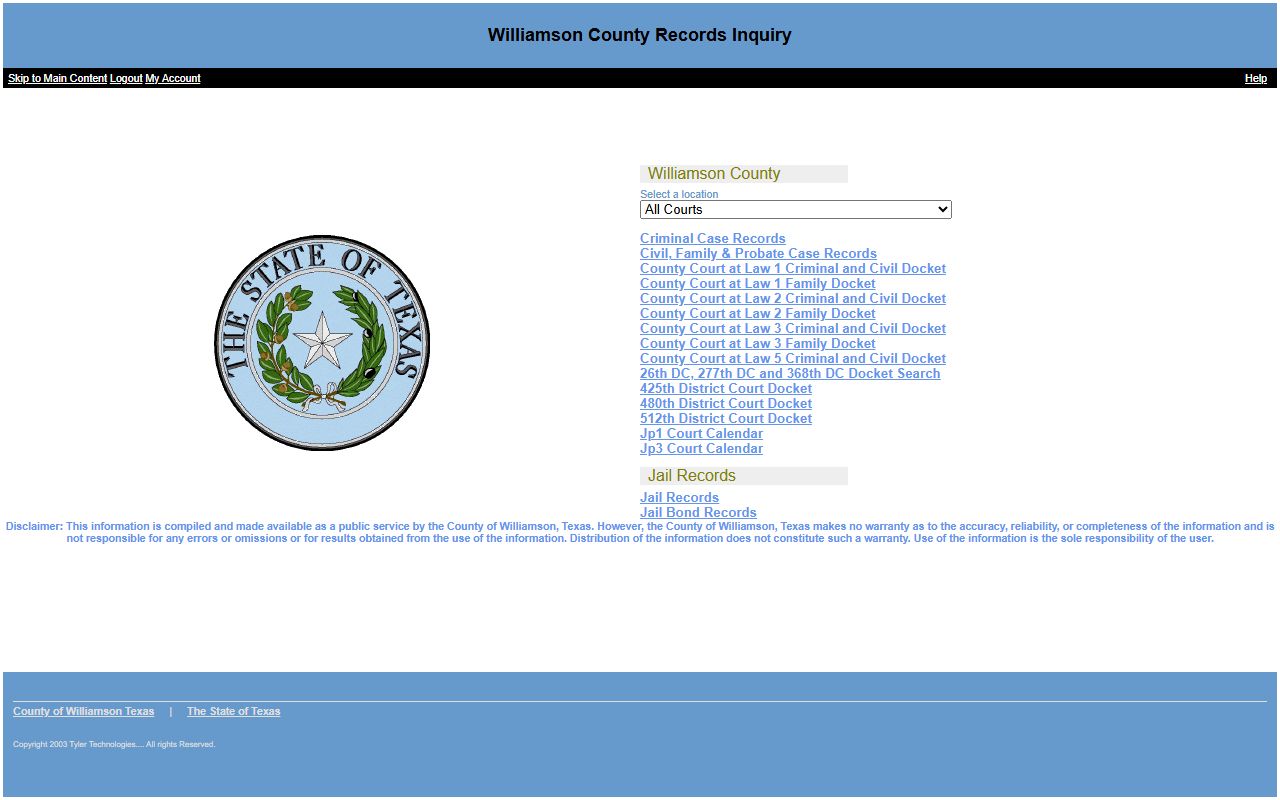
The same county lookup hub also links to jail lookup, so users can compare the filed case with the current custody record.
- Open the county Court Case Lookup page and choose Criminal Case Records.
- Search by defendant name, case number, or another precise identifier from bond or court paperwork.
- Use spelling variants if the first search fails, especially for hyphenated or shortened names.
- Open the case and review the charge list, case number, court, filing history, settings, and disposition fields that are available.
- Compare the court charge with the jail lookup when custody, bond, or release status remains unclear.
Williamson Court Search Fields
The criminal case search is another PublicAccess portal that did not expose a complete stable field inventory during command-line inspection. The county source confirms the criminal case-record link, but exact on-screen labels may depend on the browser session. Gather the following data before searching so the court record after an arrest can be narrowed without relying on one name query.
| Field Label | Type | Required | Options / Format Notes |
|---|---|---|---|
| Criminal Case Records | Portal mode or link | Yes | The county Court Case Lookup page links to Search.aspx?ID=100. |
| Defendant/name search | Text | Unspecified | Exact labels were not captured; search spelling variants. |
| Case number | Text | Unspecified | Use the number from jail paperwork, bond paperwork, citation, or court notice. |
| Filing date / date range | Date | Unspecified | Not confirmed, but common in PublicAccess systems; verify in browser. |
| Court | Dropdown | Unspecified | Not captured from source inspection. |
| Search button | Button | Unspecified | Button text was not captured. |
Arrest to Court Record
The legal path in Williamson County starts with arrest and booking, then moves to magistration and prosecutor review. Texas Code of Criminal Procedure Article 15.17 requires prompt magistrate warnings, including notice of the accusation, right to counsel, right to remain silent, right to an examining trial in felony cases, and bail matters. That early court appearance may set or address bond, but it does not mean the prosecutor has finished the formal charge decision.
After review, the case can appear in the criminal case-record portal once it is filed and indexed. Court records after a Williamson County jail arrest may show a case number, court, party or defendant, charge descriptions, filed documents, hearing settings, disposition, and sentence information depending on what the clerk makes available online. Older files, certified copies, or images not online may require clerk contact or a written request to the office that keeps the record.
Arrest -> booking -> magistration -> prosecutor review -> filed case -> hearings -> disposition is the basic flow.
Williamson Charging Documents
The court record after an arrest depends on the document used to file or advance the charge. A complaint may appear early in the case. An information is a formal prosecutor charging document often used in non-indictment prosecutions. An indictment comes from a grand jury and is commonly associated with felony prosecution. These terms describe the court accusation, not proof that the person is guilty.
| Document | Who Uses It | Common Role | What to Check |
|---|---|---|---|
| Complaint | Officer or prosecutor | Sworn accusation often used early in a criminal case. | Name, alleged offense, date, and court assignment. |
| Information | Prosecutor | Formal charging document used for many non-indictment prosecutions. | Final filed charge language and count structure. |
| Indictment | Grand jury | Charging document generally used for felonies after grand jury action. | Indicted counts, enhancements, and later amendments. |
Williamson Prosecutor Records
The Williamson County District Attorney is Shawn Dick, District Attorney for the 26th Judicial District of Texas. The official District Attorney's Office is listed at 405 M.L.K. Street, Georgetown, TX 78626, with mailing address 405 M.L.K. Street, Suite 265, Georgetown, TX 78626. The office phone is 512-943-1234 and fax is 512-943-1255. The District Attorney page and DA public-information page are relevant when the record sought is prosecutor-held rather than jail-held or clerk-held.
Prosecutor-held records can be harder to obtain during a pending case. Texas Government Code Chapter 552 allows public-information requests, but law-enforcement and prosecution exceptions may apply. Discovery rules may control some pending case material, and victims, witnesses, juveniles, medical data, sealed records, expunction orders, and security-sensitive information may be restricted or redacted.
Williamson Charge Status Terms
Charge status is one of the main reasons to search court records after a jail arrest. A jail booking may show the arresting agency's initial allegation. The court case shows what was filed and how that filed charge moves. A pending case is still unresolved. An amended or reduced charge means the filed accusation changed. A dismissal ends a charge without conviction. An acquittal means a not-guilty finding. Deferred adjudication is a Texas disposition that may avoid a final conviction if completed successfully.
| Status | What It Means | Why It Matters |
|---|---|---|
| Pending | Filed but not resolved. | Court settings, bond conditions, and custody holds may still change. |
| Amended | The prosecutor or court changed the charge. | The court record may no longer match the jail booking text. |
| Reduced | A less serious charge was substituted or accepted. | Bond, plea options, and sentence range may change. |
| Dismissed | The case or charge ended without conviction. | Expunction eligibility may depend on the full outcome and law. |
| Acquitted | Not guilty finding. | May support later record-clearing analysis. |
| Convicted | Guilty plea, verdict, or adjudication resulting in conviction. | Creates a final criminal case outcome unless later changed. |
Bond After Williamson Arrest
Bond information sits between jail custody and court case records. Texas Code of Criminal Procedure Chapter 17 governs the bail framework, while Article 15.17 covers early magistration. A bond amount shown near booking can change after a court setting, prosecutor review, indictment, bond motion, new warrant, or new hold. Always check whether another agency hold blocks release before assuming a posted local bond will free the person.
| Bond Type | How It Works | Release Caveat |
|---|---|---|
| Cash bond | Full bond amount is paid directly. | Refund and accounting depend on court rules and compliance. |
| Surety bond | A licensed bail bond company guarantees appearance. | Fee is generally not refunded, and collateral may be required. |
| Personal bond / PR bond | Court releases the person on conditions without full cash or surety. | Violation can cause revocation and return to jail. |
| No-bond hold | No ordinary release amount is available. | Court action or resolution of the hold is needed. |
| Detainer or agency hold | Another agency wants custody. | Local bond may not end custody. |
Williamson Warrants and Arrest
No standalone official Williamson County sheriff active-warrant public search was confirmed in the source set. Warrants still affect court records after an arrest in several ways. A person arrested on a warrant may appear in jail lookup after booking. Bench warrants or capias events may appear in criminal case dockets. Municipal warrants may sit with city courts in Georgetown, Round Rock, Taylor, Cedar Park, Leander, or other municipalities. Parole warrants and blue warrants are state parole matters.
Use the jail lookup after arrest, criminal case records for filed case activity, and the issuing court for bench warrants or failure-to-appear matters. The jail information line can answer custody and hold questions, but it should not be used as a substitute for legal advice. A person who believes a warrant exists should contact the issuing court, counsel, or a bond provider before appearing in person, because a walk-in can result in arrest.
Charges vs Convictions
An arrest charge and a conviction are not the same thing. A charge is an accusation or filed count. A conviction is a final outcome after a guilty plea, guilty verdict, or adjudication that produces a conviction. Court records after a Williamson County arrest should be read in stages so an unresolved charge is not treated as a final court result.
| Point | Charge | Conviction |
|---|---|---|
| Stage | Accusation at booking or formal filing. | Final court result after plea, verdict, or adjudication. |
| Proof level | Based on probable cause or prosecutor filing decision. | Requires guilty plea, verdict, or qualifying adjudication. |
| Record risk | May be pending, amended, reduced, or dismissed. | May affect sentence, custody, supervision, and criminal history. |
| Where to verify | Jail lookup and criminal case records. | Final docket entries, judgment, sentence, and clerk records. |
Sealed or Expunged Records
Record clearing in Texas is a court process, not an online lookup setting. Texas Code of Criminal Procedure Chapter 55 governs expunction for qualifying criminal records, such as some dismissals, acquittals, pardons, no-charge outcomes within statutory periods, or other eligible results. Sealing and nondisclosure are separate concepts and may leave limited access for law enforcement or other authorized users depending on the order and law.
| Point | Sealed / Nondisclosed | Expunged |
|---|---|---|
| Public visibility | Hidden from most public searches when the order applies. | Destroyed, returned, or treated as though the qualifying event did not occur. |
| Government access | Some agencies may retain limited access. | Access is much more restricted after a valid expunction order. |
| Eligibility | Depends on disposition, offense, waiting period, and Texas law. | Depends on Chapter 55 and the full case outcome. |
| Best source | Court order and clerk record. | Expunction order and agencies named in the order. |
Court Records After Arrest Limits
Williamson County public information requests must be in writing when the requested record is not available online. The county asks requesters to describe the record sought, identify the maintaining office or department, and include contact details so staff can clarify the request. County Attorney public-information routing lists hand delivery, mail, and email as approved submission methods. The DA public-information page is the better path for prosecutor-held records.
Texas Government Code 552.108 can protect some law-enforcement and prosecution information, but 552.108(c) says the law-enforcement exception does not except basic information about an arrested person, an arrest, or a crime. That basic-information rule does not make every witness statement, evidence file, juvenile record, medical detail, jail security record, sealed case, or expunged record public. Pending cases often require a careful split between clerk-held filings, prosecutor-held files, and jail custody records.
Important: Court records after a jail arrest can change as charges are amended, dismissed, indicted, or resolved.